1. Rail Baltica: Project Overview
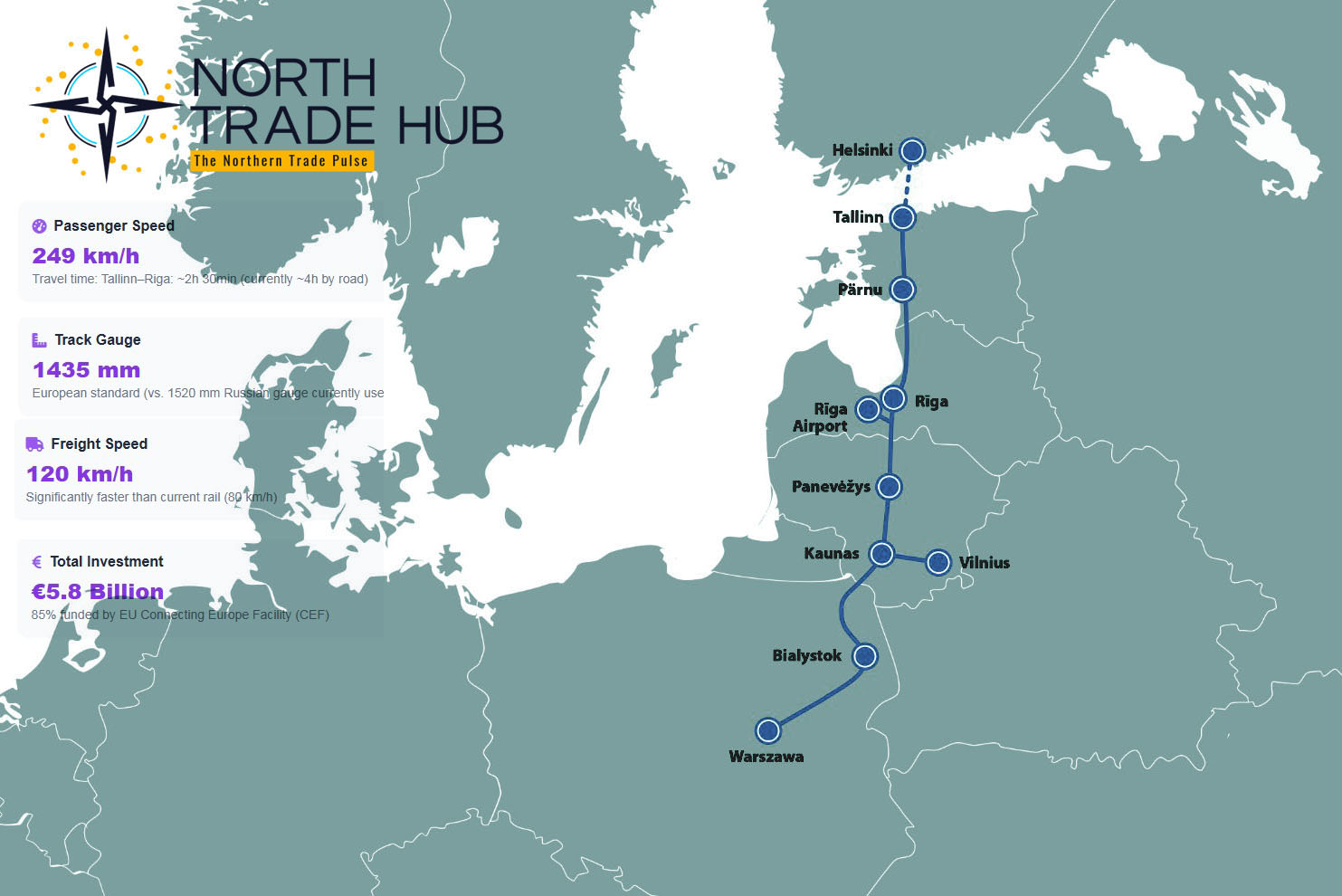
Rail Baltica is one of the most ambitious greenfield infrastructure projects in Europe. Its primary goal is to integrate the Baltic States (Estonia, Latvia, and Lithuania) into the European rail network using the standard European gauge of 1435 mm. Currently, the Baltic countries operate on the 1520 mm Russian gauge, which isolates them from the rest of Europe.
The project spans 870 kilometers, creating a high-speed link from Warsaw through Kaunas, Riga, and Tallinn. For the Nordic countries, specifically Finland, this project includes a proposed undersea tunnel or enhanced ferry link that will allow goods to travel from Helsinki to Berlin by rail in record time.
2. Technical Specifications
Passenger Speed
249 km/h
Tallinn–Riga: ~2h 30min (currently ~4h)
Freight Speed
120 km/h
Significantly faster than current rail (80 km/h)
Track Gauge
1435 mm
European standard (vs. 1520 mm Russian gauge)
Total Investment
€5.8 Billion
85% funded by EU Connecting Europe Facility (CEF)
3. Route: Connecting the Baltics to Europe
The main line runs from Tallinn (Estonia) through Pärnu to Riga (Latvia), then through Panevėžys to Kaunas (Lithuania), and continues to the Polish border near Šeštokai. From there, it connects to the existing European rail network towards Warsaw and beyond.
| Country | Major Stops | Length | Status |
|---|---|---|---|
| Estonia | Tallinn, Pärnu | 213 km | Design/Construction |
| Latvia | Riga, Salaspils | 265 km | Design/Construction |
| Lithuania | Kaunas, Panevėžys | 392 km | Partially Operational |
| Poland | Warsaw, Białystok | ~200 km | Operational |
4. Economic Impact
- €16.2 billion in quantifiable socio-economic benefits over 30 years
- 40,000+ direct and indirect jobs during construction and operations
- €1.5 billion annual GDP contribution once fully operational
- Modal shift: 5-10 million tons of freight expected to shift from road to rail by 2040
- Real estate appreciation: Areas near Rail Baltica stations projected to see property value increases of 10-20%
5. Multimodal Logistics Hubs
| Hub | Country | Connection | Expected Capacity |
|---|---|---|---|
| Muuga | Estonia | Port of Tallinn | 1M TEU/year |
| Salaspils | Latvia | Riga Port + Airport | 800k TEU/year |
| Kaunas | Lithuania | Intermodal Terminal | 500k TEU/year |
| Panevėžys | Lithuania | Industrial Zone | 300k TEU/year |
These hubs will enable seamless "sea-to-rail" and "air-to-rail" transitions, making the region a global competitor in supply chain efficiency.
6. Green Transition: CO₂ Reduction
- Reduce CO₂ emissions by 1.5 million tons annually by 2040
- Eliminate 200,000 truck journeys per year between the Baltics and Central Europe
- Use 100% renewable energy for traction power (wind and hydro from Baltic states)
- Support EU's Green Deal and Fit for 55 targets
7. Project Status 2026: Where Are We Now?
Challenges: Rising construction costs (inflation), environmental permitting delays, and land acquisition issues have pushed full completion to 2030. However, the project remains a top priority for the EU and national governments.
8. Business Opportunities Along the Rail Baltica Corridor
- Industrial parks: New zones are being developed near major stations (e.g., Pärnu Industrial Park, Salaspils Logistics Zone).
- Cold chain logistics: Perishable goods can now reach Western Europe faster via temperature-controlled rail.
- E-commerce fulfillment: Warehouses near Rail Baltica hubs can serve a 200 million consumer market in Central Europe.
- Construction & engineering: Tenders for rail infrastructure, electrification, and station buildings continue through 2028.
- Rail freight forwarding: New intermodal services will require freight forwarders with Rail Baltica expertise.
9. Frequently Asked Questions (SSS)
Q: When will Rail Baltica be fully operational?
A: Full completion is targeted for 2030. The Kaunas–Polish border section is already operational. Estonia's Tallinn–Pärnu section is expected by 2029-2030.
Q: How much will passenger tickets cost?
A: Pricing is not yet finalized, but estimates suggest Tallinn–Riga one-way fares will be €25-35 (comparable to bus fares but faster).
Q: Will Rail Baltica carry freight from day one?
A: Yes, freight services are planned to start simultaneously with passenger services. Freight trains will operate primarily at night to maximize track capacity.
Q: How is Rail Baltica funded?
A: 85% from EU's Connecting Europe Facility (CEF). The remaining 15% is covered by the three Baltic states and Poland.
Q: What about the Helsinki–Tallinn tunnel?
A: The undersea tunnel is a separate project (FinEst Link) but would integrate with Rail Baltica. Feasibility studies are ongoing; no construction timeline yet.